Oct 13, 2026Buying Guides
Differences Between Synthetic and Natural Hair Makeup Brushes
This article provides a detailed analysis for makeup brush buyers regarding the differences between synthetic fiber brushes and natural hair brushes.
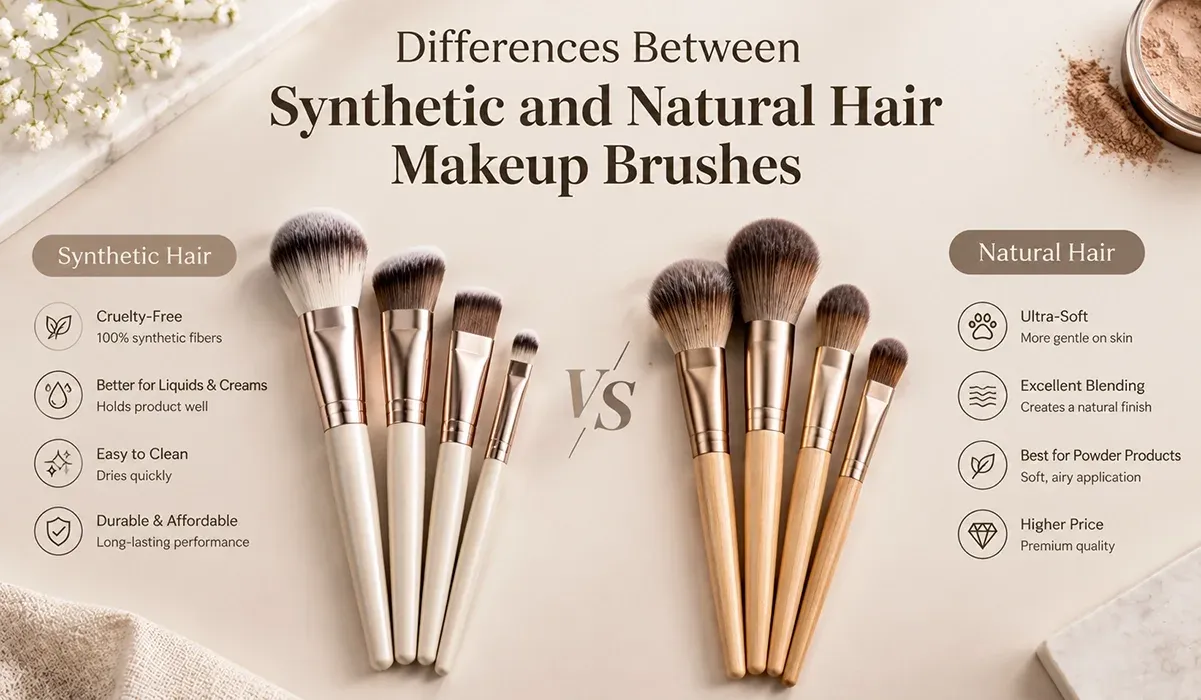
For makeup brush buyers, selecting bristle material is not a question of which type is inherently "better," but rather a decision regarding which material best suits a specific type of product. This assessment is grounded in the differences in the microscopic structures of the materials; these structures dictate how the bristles pick up and release product and interact with the skin, thereby determining the specific capabilities and limitations of each brush. Only by understanding this relationship can purchasing decisions shift from being based on mere experience to being grounded in solid, evidence-based reasoning.
1.Microstructure: The starting point for understanding all differences.
Natural animal hair is covered with scales that overlap like the texture of a pinecone, creating an irregular, microscopic, textured surface. It is this structure that gives animal hair its exceptional ability to pick up powder: powder particles embed themselves in the gaps between the scales and become "locked" onto the surface of the bristles, preventing excessive fallout during application while ensuring an even release upon contact with the skin. Consequently, makeup brushes made from natural animal hair excel at both picking up and releasing powder, resulting in a natural-looking finish—which is the fundamental reason why high-end brushes predominantly use natural animal hair.
In contrast, synthetic fibers (primarily polyester and nylon) feature smooth, coated surfaces devoid of a scale structure, making it difficult for powder particles to adhere. Industry tests show that while animal hair has "strong" powder-pickup capabilities—thanks to the scale structure that easily grips the powder—synthetic fibers are "weak" in this regard, as their smooth surfaces do not readily retain product. However, this smooth surface offers a different set of advantages: synthetic fibers do not absorb water or oils. When used with liquid or cream products, they spread the product evenly across the skin rather than "drinking" it into the bristles. Residue of liquid foundation on synthetic brushes is minimal, allowing for virtually zero waste.
This difference in microscopic structure directly defines the functional boundaries of these two types of bristles.
2.Powder-based products: The primary domain for natural hair
Applying dry powder products—such as loose powder, blush, eyeshadow, and contour powder—is where the unique cuticle structure of animal hair truly shines. The natural cuticles provide excellent powder-gripping capability, allowing the brush to pick up an ample amount of product and distribute it evenly through the gaps between the scales for a natural, blended finish; the result is a soft color transition without harsh edges.
However, animal hair is not a uniform category; different types vary significantly in the balance of "powder-gripping power, softness, and elasticity," which directly determines their suitability for specific brush shapes.
Goat hair is the most common material; it is soft, durable, and resilient, with strong powder-pickup capabilities, making it widely used for loose powder, blush, contour, and eyeshadow brushes. Within this category, "fine-grade goat hair" (such as *Saikoho*) represents a premium tier, offering strong powder grip alongside a perfect balance of elasticity and softness; it is frequently used for high-end foundation and multi-purpose face brushes.
Grey squirrel hair is renowned for its exceptional softness and fineness; the hairs are extremely thin at the base with straight, delicate tips, offering a sensation akin to a cloud brushing against the skin. While its elasticity is relatively low and its powder pickup is even but gentle, it is ideal for finishing powder and blush brushes, creating a sheer, lightweight finish that prevents the "monkey-butt" look caused by over-application. Due to its rarity and lustrous sheen, it is considered a high-end material.
Squirrel hair is the softest and smoothest, feeling incredibly comfortable on the face, though it has relatively weak powder-pickup and elasticity. It is typically used for blush and contour brushes; even without precise application techniques, using squirrel hair makes it difficult to create heavy, patchy spots of color.
Yellow weasel tail hair sits at the opposite end of the spectrum: it is soft yet resilient and highly durable, excelling in pigment pickup and oil resistance, though its blending capability is merely average. It is most commonly used for lip, eyeliner, concealer, and eyeshadow brushes, and commands the highest price point among animal hair types. Mink hair features a fine texture and excellent elasticity; it picks up eyeshadow powder perfectly while minimizing fallout, making it ideal for tools requiring precise control, such as eyeshadow and concealer brushes. Some manufacturers blend 30% synthetic fibers into the mink hair to enhance overall elasticity, demonstrating that even high-end animal hair may require blending to compensate for the performance limitations of a single material.
Horse hair offers moderate elasticity and softness; while it delivers good color payoff, it can feel prickly if used with a vertical poking motion. Being relatively inexpensive, it is commonly used for eyeshadow base brushes and nose contour brushes, and is frequently blended with other hair types to reduce costs.
For purchasers, the key takeaway is that selecting bristles for dry-powder brushes involves far more than simply opting for "animal hair." High-end loose powder brushes utilize gray squirrel or fine-grade goat hair; eyeshadow blending brushes use goat or mink hair; nose contour brushes employ horse hair; and blush brushes—designed for customers wary of applying too much product—feature squirrel or gray squirrel hair. Ultimately, the choice of bristle material directly determines the product's user experience and market reputation.
3.Liquid and cream products: An area where synthetic fiber bristles are irreplaceable.
When transitioning from dry powder products to liquid or cream formulations, the logic behind selecting brush bristles shifts fundamentally. Synthetic fiber brushes are typically preferred for liquid or cream cosmetics because the bristles are firm, resilient, and non-absorbent—making them easy to clean—which is why most foundation brushes are made from man-made fibers.
The advantages of synthetic fibers for liquid-based products can be categorized into three levels:
First, they do not absorb the product, resulting in zero waste. The smooth surface of the fibers ensures that liquid foundations and concealers are not "soaked up" into the depths of the brush head but are instead spread evenly across the skin. Aside from brushes made of premium sable hair, synthetic brushes offer the best performance with liquid products; because the bristles do not absorb liquid, they release the foundation steadily and evenly during application, achieving virtually zero waste.
Second, they provide high coverage and a substantial finish. When applying liquid and cream products, synthetic brushes offer superior coverage and opacity compared to animal hair, resulting in a more solid, defined finish. This is due to the physical rigidity of the fibers: unlike animal hair, which disperses pressure through the gaps between its scales, synthetic fibers concentrate the product and push it effectively onto the skin's surface.
Third, brush strokes are controllable, making them ideal for precision work. The resilience of synthetic fibers makes them easier to use when defining intricate shapes, making them suitable for products requiring precise control, such as liquid foundations, concealers, and lip glazes. Foundation brushes require sufficient stiffness and elasticity to spread product evenly, and synthetic fibers outperform most animal hair in this regard.
Synthetic fibers themselves come in various materials, a distinction that directly influences product positioning. Taklon, a polyester-based thermoplastic fiber, was developed specifically to mimic the feel of natural sable hair; it is soft, smooth, and versatile, making it suitable for a wide range of makeup brushes. Nylon, by contrast, is stiffer and more rigid, making it ideal for applications requiring greater structural support and precision, such as detail-oriented tools like mascara wands and eyebrow brushes. When commissioning custom foundation brushes, buyers should select the fiber type based on the desired makeup finish: opt for soft Taklon-style fibers for a lightweight, dewy look, and choose stiffer nylon-style fibers for high coverage.
When planning product categories, buyers should take note of a significant trend: the tactile feel of synthetic bristles is rapidly approaching that of natural animal hair. High-quality synthetic fibers now rival pure wool in terms of texture and powder pickup, with some performance metrics even surpassing it. This implies that in the mid-range market, synthetic bristle products need no longer be positioned merely as "cheap alternatives"; instead, they can enter the market with a specialized functional identity. Buyers can reposition synthetic brushes from "entry-level, high-volume items" to "professional-grade tools for liquid formulas"—a strategic shift that could drive higher average transaction values and enhance product differentiation.
If you would like to learn more about makeup brushes, please feel free to contact us.