Oct 14, 2026Buying Guides
Private Label Makeup Brushes for Amazon FBA Sellers: A Perfect Sourcing Guide
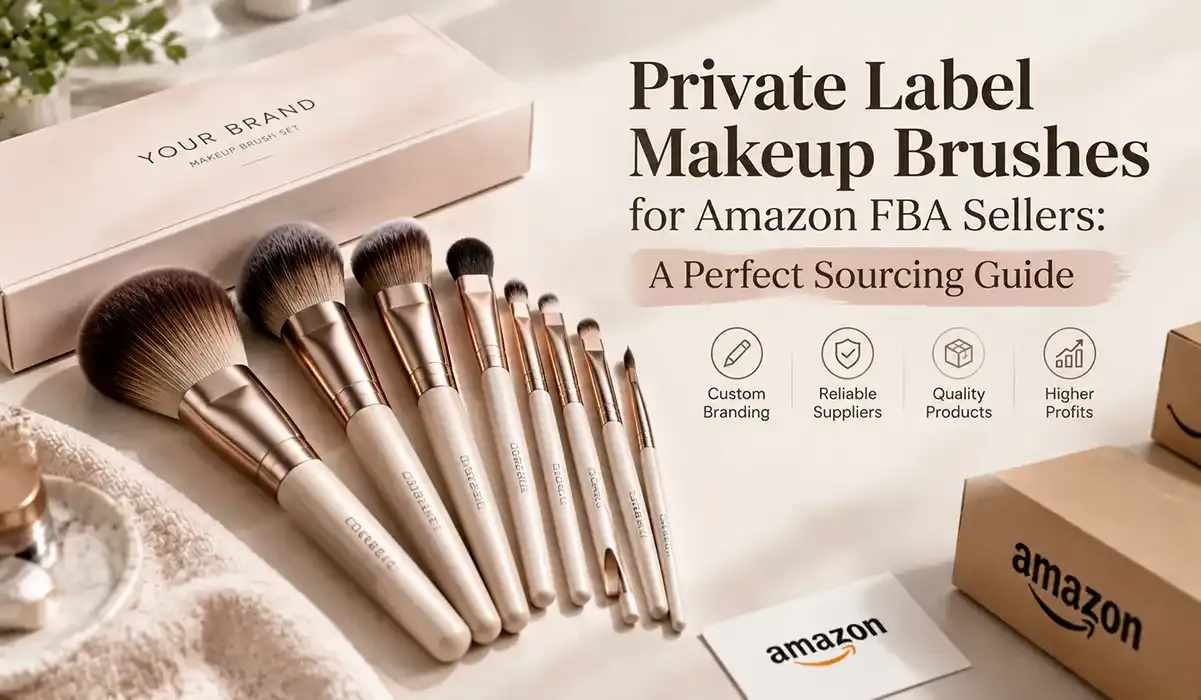
This article provides the ultimate guide for Amazon FBA sellers looking to source private-label makeup brushes.
Private Label Makeup Brushes for Amazon FBA Sellers: A Perfect Sourcing Guide
1.Why Amazon FBA sellers are shifting to custom private labels
1.1 Industry Background: The Profit Structure of the FBA Model Is Being Reshaped
The operational landscape for Amazon FBA has undergone fundamental changes in recent years. FBA fees, storage charges, and advertising costs have steadily risen; a typical private-label seller now allocates 50%–60% of their revenue to various Amazon fees, with some sellers seeing this figure reach as high as 70%. Meanwhile, Amazon PPC costs-per-click have climbed year over year—particularly in highly competitive, high-demand categories—making advertising expenditure one of the primary factors eroding profit margins.
This issue is particularly acute in the makeup brush category. Many key brush segments are saturated, and highly commoditized private-label products compete primarily on price; price floors have been compressed to levels where most US-based FBA sellers struggle to remain profitable after deducting Amazon fees, inbound shipping costs, and return processing expenses. A makeup brush with an ex-factory price of just a few RMB might sell for four or five USD on Amazon—resulting in a loss even before advertising costs are factored in—illustrating the intensity of the competition.
In this environment, the business model of simply "sourcing generic products, slapping on a logo, and driving rankings via SEO and PPC" is no longer sustainable. Sellers must identify new dimensions of competition.
1.2 Core Value of Private Labeling
(1) From "Selling Products" to "Building Assets"
Under wholesale or generic product models, sellers are essentially helping others build their brands. In contrast, every sale, review, and repeat customer associated with a private label accumulates business assets that belong to the seller. For product categories like makeup brushes—where consumers tend to replace items regularly and repeat purchases are common—the cumulative effect of brand equity is particularly pronounced. In Amazon’s beauty category, buyer loyalty and repurchase rates are among the highest on the platform; a product with a rating above 4.5 stars and a clear brand identity can consistently generate monthly revenue in the five- to six-figure range with virtually zero customer acquisition costs.
(2) Escaping Buy Box Competition and Price Wars
In the generic product model, multiple sellers compete for the "Buy Box" on the same listing, inevitably leading to price wars and margin compression. Private labeling grants sellers full control over the listing, pricing, and customer experience, fundamentally eliminating this structural issue. For categories like makeup brushes—which feature numerous SKUs and allow for visual differentiation—private label control enables sellers to precisely tailor product specifications, packaging designs, and visual presentation to their target audience's preferences, rather than being constrained by the fixed forms of generic products.
(3) Product Iteration and Differentiation Capabilities
Private labeling allows sellers to continuously optimize products based on customer feedback—such as improving bristle materials, adjusting brush set combinations, upgrading storage case designs, or launching new colorways and co-branded editions. Such flexibility is impossible when reselling other manufacturers' products. The scope for differentiation in the makeup brush category is vast: handle colors, bristle shapes, set configurations, and packaging styles. Customizing these elements often results in only a marginal increase in unit cost while supporting a higher retail price point.
(4) Platform Algorithms and Tools Favoring Brands
Amazon’s algorithms are clearly shifting to favor brand-owning sellers. By 2026, over 70% of Amazon shoppers will consider brand reputation before making a purchase. The platform leverages tools such as Brand Registry, A+ Content, Brand Stores, and video advertising to provide brand sellers with traffic and conversion advantages unavailable to generic sellers. With the launch of AI-driven shopping features like COSMO and Rufus, factors such as conversion rates, sales velocity, and customer experience signals have gained greater weight in search rankings—effectively rewarding sellers who operate like genuine brands.
(5) Unique Suitability of the Makeup Brush Category
As beauty tools, makeup brushes hold a key advantage over color cosmetics: consumers do not pay the steep premiums associated with major beauty brands, focusing instead on practicality and the user experience. This lowers the barrier to entry for new brands; the value proposition stems from the product's distinctive design and perceived quality rather than the brand's historical pedigree. Consequently, this offers a viable path for small and medium-sized FBA sellers to enter the market with their own private-label products.
Sixplus serves as a noteworthy case study. Originally an ODM manufacturer for the world's top five beauty conglomerates, the company launched its own brand in 2012 and expanded into the Amazon Japan marketplace. Through localized innovations—such as "cat-paw" shaped makeup brushes—it achieved sales of 90 million JPY in its first year and has consistently held the number one spot in Amazon Japan’s beauty tools category for six consecutive years. The logic behind Sixplus's success is clear: rather than engaging in price wars, the brand established differentiation through unique product design and positioning, thereby escaping the "red ocean" of commoditized competition.
2.Which types of makeup brushes tend to perform well on Amazon?
2.1 Travel-Sized Makeup Brush Sets
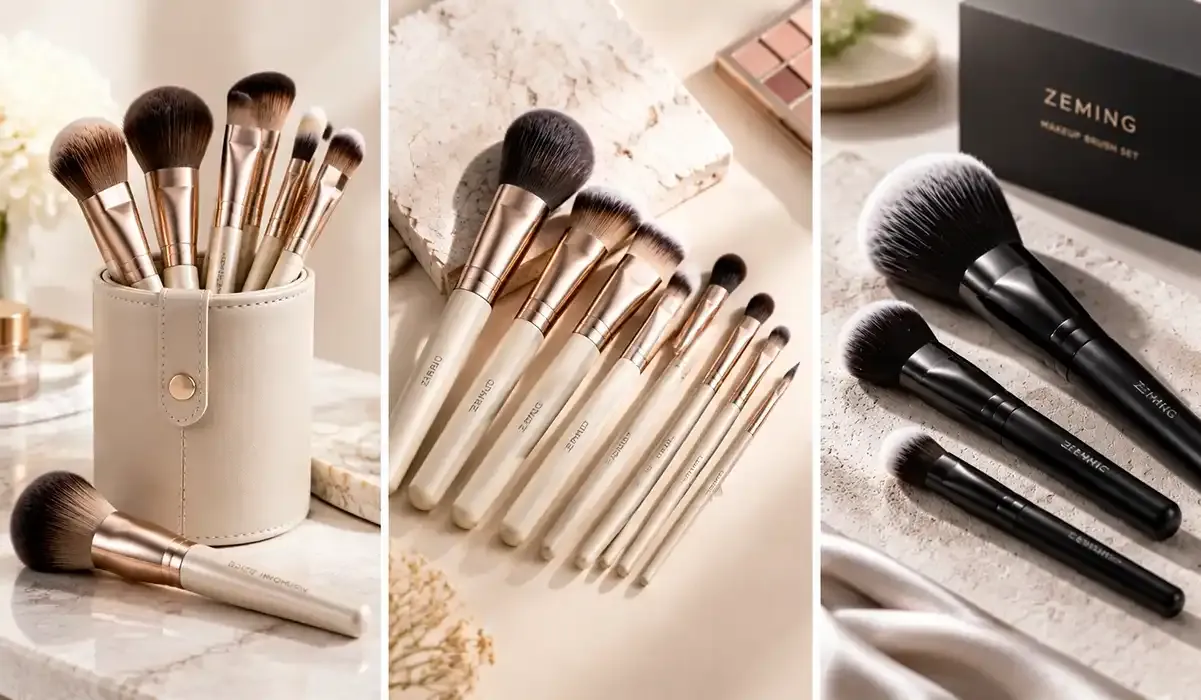
When selecting products within the makeup brush category, FBA sellers should take note of a significant trend: travel-sized makeup brush sets (typically containing 5–8 brushes and a storage pouch or hard case) consistently outperform full-sized sets from the same brands on Amazon.
The strong performance of travel-sized brush sets stems primarily from their unique, indispensable use cases. Unlike standard brushes, the primary driver for travel sets is not a desire to upgrade or try something new, but a specific situational need: the requirement for a portable, comprehensive set of tools that saves space while traveling.
This demand is steadily growing. Industry reports indicate that retractable and travel-friendly brush sets are gaining market traction by catering to the modern consumer's "on-the-go" lifestyle; beauty needs during travel and while mobile are key drivers of growth for portable makeup tools. Meanwhile, the rising popularity of "minimalist beauty" has further accelerated this trend, as consumers increasingly favor portable, efficient, and multifunctional tools—evidenced by the significant sales growth of multifunctional dual-ended brushes and travel-friendly sets on e-commerce platforms.
Amazon search results reveal that travel-sized brushes have established a distinct search intent. Procurement guides identify "Travel-Format Brush Sets (5–8 piece sets with storage cases)" as a highly profitable category for FBA sellers through 2026, noting that these products effectively target three specific search scenarios: gifting, travel, and entry-level purchases. This means sellers can compete not only for broad terms like "makeup brush set" but also capture high-conversion traffic by targeting situational keywords such as "travel makeup brush set" and "mini brush set."
Customer reviews on Amazon further validate this scenario-driven purchasing behavior. One buyer noted: "I travel frequently and only carry a carry-on suitcase. This is a great portable brush set; while the quality isn't quite up to the standard of the ones I keep at home, the convenience is unmatched." Another user mentioned: "I started buying travel-sized sets because I didn't want to lug around long brushes that wouldn't fit in my makeup bag during business trips; this set fits the bill perfectly." The common thread here is that consumers have pragmatic expectations regarding the quality of travel-sized brushes, prioritizing portability and suitability for specific use cases over matching the exact quality of full-sized products.
2.2 Multifunctional Dual-Ended Brushes
When selecting products within the makeup brush category, multifunctional dual-ended brushes represent another niche segment that FBA sellers should prioritize. Unlike the success factors behind travel sets, the core competitive advantage of dual-ended brushes lies not in the completeness of a storage solution, but in a more fundamental value proposition: combining two functions into a single tool, allowing consumers to complete their makeup routine with fewer items.
This logic is directly validated by Amazon sales data. Take e.l.f.’s Dual-Ended Cream + Powder Brush, for example: it achieved a monthly sales volume of 10,000 units in July 2026—a 100% month-over-month increase—making it the fastest-growing product for its corresponding search terms. Another product, e.l.f.’s Liquid Bronzer & Contour Duo Brush, has consistently held the number six spot in the contour brush category, while Jessup’s 7-piece dual-ended brush set has also garnered a solid reputation among consumers. These figures demonstrate that dual-ended brushes are not merely niche novelty items; they represent a clear consumer demand and a replicable business model.
The strong performance of dual-ended brushes on Amazon is driven, first and foremost, by the growing adoption of the "minimalist beauty" philosophy. In recent years, consumers have increasingly favored portable, efficient, and multifunctional makeup tools, leading to a marked rise in sales for dual-ended brushes, travel-friendly sets, and versatile, multi-use products across e-commerce platforms. Consumers prioritize not only a product's aesthetics but also its practical efficiency and ease of storage; industry analysis generally identifies multifunctionality and lightweight design as key directions for innovation in makeup brushes.
The underlying driver of this trend is a fundamental shift in consumer habits. Modern beauty consumers no longer wish to own a multitude of brushes that clutter their drawers; instead, they prefer to achieve the same—or even a more comprehensive—makeup look using fewer tools. Dual-ended brushes perfectly address this need: a single brush combining foundation and concealer functions replaces the two separate brushes previously required, allowing consumers to experience a tangible boost in efficiency during their daily routines.
The influence of social media cannot be overlooked, either. Since 2022, sales of dual-ended eyeshadow brushes, foundation-concealer combos, and travel-sized dual-ended tools on Amazon have seen substantial growth. This surge is driven by a combination of factors: the viral "two-tool" makeup routines on TikTok, the demand for travel sets, and the rise of minimalist brand aesthetics. The short-video format of TikTok is ideal for showcasing dual-ended brushes; influencers can clearly demonstrate in just a few dozen seconds how one brush handles two steps of a makeup routine. This intuitive visual presentation significantly lowers the barrier to understanding for consumers, accelerating the journey from product discovery to purchase.
Consumer reviews fully validate this purchasing rationale. One buyer noted, "The dual-ended design allows me to easily use both cream and powder products without needing multiple brushes; the bristles feel soft and smooth while offering excellent control and an even finish." Another user highlighted the practicality of the design: "The bristles don't shed, it feels incredibly soft, and it works beautifully for applying both foundation and loose powder. Plus, the dual-ended feature makes it so convenient to use." A common theme across these reviews is that consumer satisfaction stems largely from "functional consolidation"—a single brush performing tasks that previously required two or even three separate tools.
2.3 Vegan and Eco-Certified Makeup Brush Sets
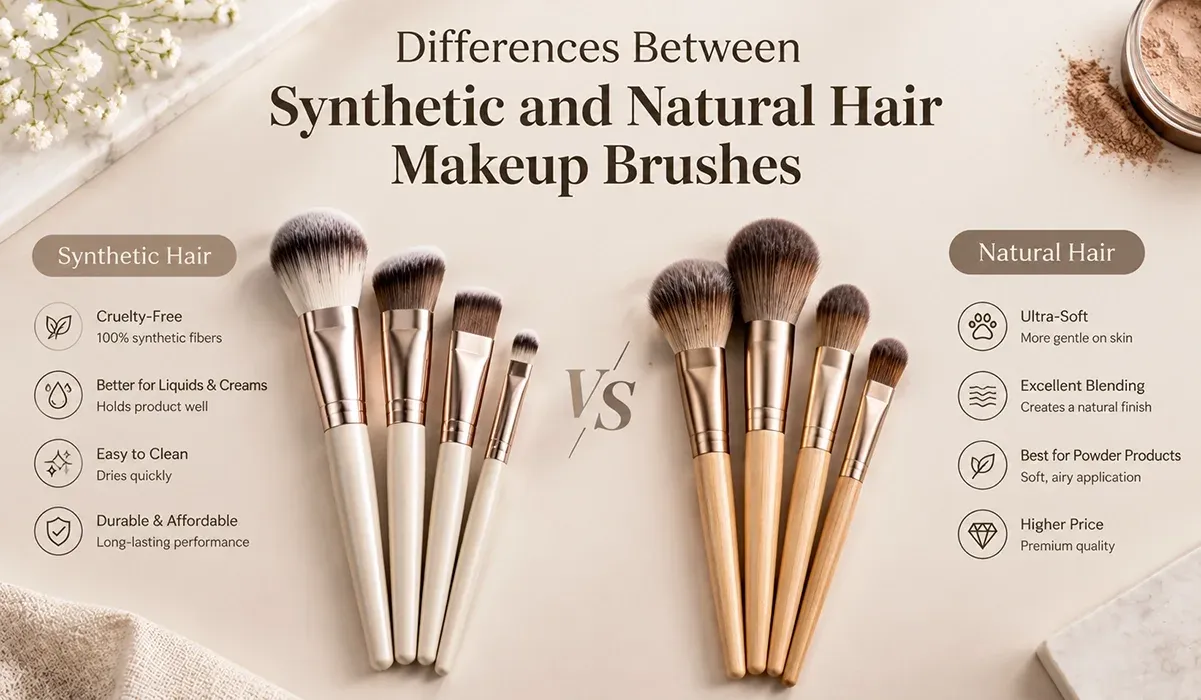
Within the makeup brush category, a specific segment is rapidly gaining momentum: vegan and eco-certified makeup brush sets. Here, "vegan" implies that the bristles are made of synthetic fibers, handles are processed without beeswax or animal fats, and no components contain animal-derived ingredients; "eco-certification" encompasses credentials such as Leaping Bunny or PETA cruelty-free certification, FSC forest certification, and Amazon’s Climate Pledge Friendly (CPF) badge.
The strong performance of vegan makeup brushes on Amazon is primarily driven by a structural shift in consumer behavior. Global market data indicates that in 2023, sales of makeup brushes free from animal ingredients accounted for 52% of the global market, surpassing the 48% share held by natural-hair brushes for the first time. Industry forecasts predict a 5% annual decline in the natural-hair brush market, contrasted by a 12% compound annual growth rate (CAGR) for vegan brushes. This turning point marks the transition of vegan brushes from a mere "alternative" to a "mainstream" choice.
Younger consumers are the primary drivers of this shift. Survey data reveals that 73% of consumers aged 18 to 34 cite "cruelty-free" status as the most important factor when purchasing makeup tools. Social media has accelerated this trend; hashtags such as #VeganBeauty and #CrueltyFreeTools have garnered over 5 billion cumulative views on TikTok, transforming ethical consumption from an individual choice into a cultural movement. On Amazon, this trend is reflected in consumers actively looking for certification labels—with some buyers explicitly stating they "only purchase brands certified by Leaping Bunny," viewing such certification as a fundamental benchmark for brand credibility.
Crucially, advancements in synthetic bristle technology have eliminated consumer concerns regarding the performance of vegan brushes. Early synthetic bristles suffered from issues such as stiffness, shedding, and poor powder pickup. However, advancements in PBT fiber and biomimetic bristle technology have enabled synthetic bristles to rival—or even surpass—natural hair in terms of softness, elasticity, and powder pickup. They also offer a lifespan two to three times longer than natural hair brushes, along with hypoallergenic properties and resistance to bacterial buildup, making them particularly suitable for sensitive skin. Consequently, choosing vegan-certified brushes is no longer a compromise where quality is sacrificed for ethics; rather, it is a rational decision that delivers both ethical value and high performance.
2.4 Makeup Brush Sets for Beginners
Within the makeup brush category, beginner sets represent a market segment with proven success. Amazon’s "Best Seller" lists consistently feature the BS-MALL 18-piece set, which holds the "#1 Best Seller" and "Beginner-friendly" tags; the Real Techniques "Everyday Essentials" set is recognized by WWD as "good for beginners"; and the e.l.f. Professional 12-piece set, priced at $12, maintains a solid ranking within the top 1,500 products in the brush category. These products share a common trait: while neither the most expensive nor the most professional-grade options, they occupy the optimal position within Amazon’s algorithms and the consumer decision-making journey.
The strong performance of beginner sets stems from their ability to directly address a core anxiety shared by a specific group of consumers: "I need makeup brushes, but I don't know which ones to buy."
Research into user segmentation for Amazon sets reveals that makeup beginners account for 25% of all buyers in this category. Their needs are clear: they require explicit guidance on brush usage, prefer complete sets that include instructions or labels, and are highly price-sensitive. Their behavioral patterns differ fundamentally from those of everyday users; the latter already know what they need and engage in more purposeful searches, whereas beginners are often in a "learning and discovery" phase. Beginners use broader search terms and rely heavily on visual cues and information clarity within product listings to make decisions.
Beginner sets provide the perfect solution to this "choice paralysis." A set comprising 12 to 18 brushes—covering essentials such as foundation, loose powder, blush, eyeshadow, and eyeliner—paired with clearly labeled usage instructions or a manual, effectively serves as an "all-in-one learning kit." LUXBRU’s product listing explicitly highlights the inclusion of a user guide featuring diagrams of each brush's function and cleaning instructions; this approach to information design directly addresses the common beginner dilemma of not knowing which brush to use for what purpose.
From the perspective of consumer psychology, the decision to purchase an entry-level set leans closer to an "impulse buy" than the purchase of a professional-grade set. A WWD report cited consumer feedback noting that "even if you end up disliking one of the brushes, the value of the entire set remains." This positioning as a "low-risk trial" makes it easier for beginners to convert from browsing search results to placing an order.
3.Customize OEM makeup brushes tailored to Amazon search results.
3.1 Handle Color
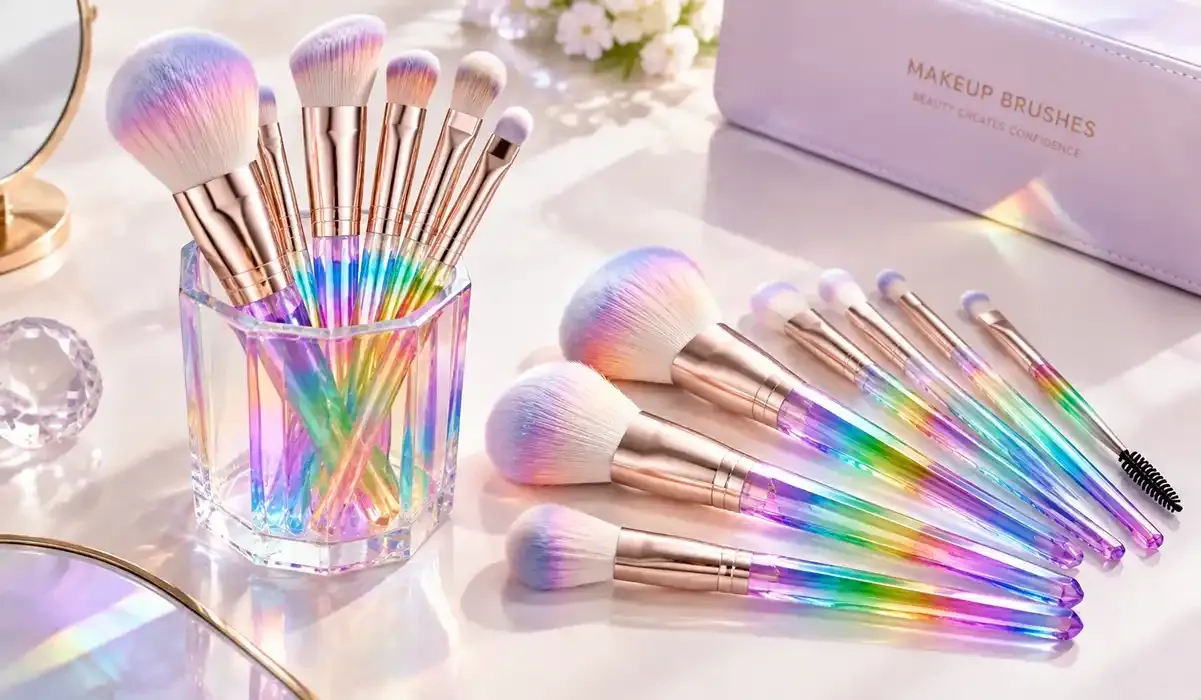
In private-label customization for makeup brushes, handle color is often treated merely as a final aesthetic choice. However, looking at actual competition on Amazon search results pages, color is far more than an aesthetic matter; it is the primary visual signal consumers use to identify your product, a semantic clue for algorithms (like COSMO and Rufus) to interpret product intent, and a differentiation lever that offers the lowest cost barrier and fastest iteration speed in OEM customization.
For Amazon FBA private-label sellers, if the decision on color stops at simply "picking a nice-looking shade," they are squandering its potential as a tool for search competition.
Selecting a makeup brush handle color for 2026 requires understanding a unique situation: two major trend forecasting agencies have proposed "Colors of the Year" that point in diametrically opposite directions.
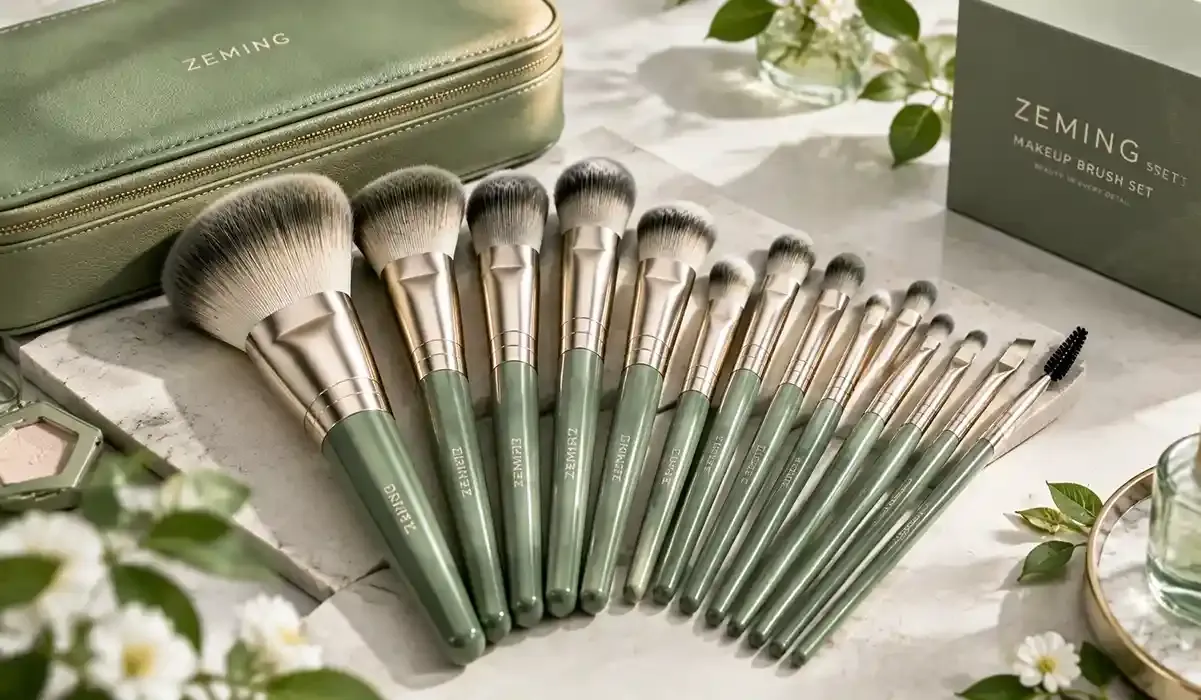
Pantone’s 2026 Color of the Year is "Cloud Dancer"—a soft, warm white that conveys airiness, serenity, and a near-neutral, minimalist aesthetic. In contrast, WGSN’s 2026 Color of the Year is "Transformative Teal"—a saturated, jewel-toned blue-green that conveys depth, confidence, and a more dramatic shelf presence. Centered around these two anchors, the Coloro × WGSN S/S 2026 supplementary palette includes Sage Green, Soft Coral, Buttery Yellow, and Slate Blue—these are the color ranges where most brands will actually allocate their development budgets.
For Amazon FBA sellers, these two sets of "Colors of the Year" actually correspond to two distinct search competition strategies.
The warm white of "Cloud Dancer" aligns with search intent driven by "clean beauty" and "minimalist" aesthetics. When consumers search for terms like "vegan makeup brush set" or "clean beauty brushes," products with warm white handles naturally achieve greater visual coherence on the search results page—effectively signaling, "My product belongs to the clean beauty category." However, it is important to note that warm white is extremely "honest" in OEM production: fingerprints, gaps at the ferrule, glue residue, and batch-to-batch color drift are all magnified on a warm white surface. Most "Cloud Dancer" (off-white) concepts currently in development utilize the profiles of oversized loose-powder brushes and buffing brushes rather than dense kabuki styles; this is because a softer silhouette allows the warm white tone to be "read" by consumers on the shelf as a deliberate design choice rather than a coincidence.
"Transformative Teal," by contrast, points toward a completely different search scenario. Its saturated jewel tone is visually more assertive on the shelf, making it better suited for products positioned as "statement pieces." The dye chemistry for achieving teal on anodized aluminum ferrules has been refined by the consumer electronics industry over decades; with saturated colors, slight batch-to-batch tonal shifts are perceived as "teal" rather than as "defects." This means the margin for error in OEM quality control is far greater for Teal than for Cloud Dancer, making it a safer choice for FBA sellers venturing into color customization for the first time.
3.2 Bristle Color
While handle color decisions center on "getting consumers to recognize you at a glance on the search results page," the logic for bristle color differs—it is less about vying for attention and more about building trust. When consumers see a makeup brush with white bristles in search results, they instinctively associate it with "goat hair, softness, and natural materials," whereas black bristles trigger associations with "synthetic fibers, durability, and suitability for cream-based products."
From a sourcing perspective, customizing bristle color requires Amazon sellers to clarify several key factors when communicating with suppliers.
Rule number one: bristle color must be confirmed in conjunction with the bristle material and functional positioning. The coloring processes for synthetic bristles (PBT, nylon, Taklon) differ significantly from those used for natural hair. Synthetic fibers are typically colored during production—either via solution dyeing or post-spinning dyeing—offering relative flexibility; however, dyeing processes for dark colors (especially black and dark brown) can impact fiber softness and elasticity. Dermatological advice suggests that the dyes used for black bristles may compromise fiber strength, so opting for white, tan, or undyed bristles can help extend the brush's lifespan. This means that if a seller aims for the professional look associated with "black bristles," they must explicitly require the supplier to provide softness test data for the dyed bristles during the prototyping stage, ensuring that the coloring process does not compromise the user experience.
Rule No. 2: For dual-colored bristles, quality standards regarding the color transition must be established. There are two ways to achieve dual-colored bristles: color segmentation within the fiber itself (completed during the fiber production stage) and dip-dyeing after the bristles have been assembled. The former offers better consistency but less customization flexibility, while the latter allows for on-demand customization but carries a higher risk of batch-to-batch color variation. During the prototyping stage, sellers need to clearly define the transition point (e.g., whether the transition begins at the one-third mark or the halfway point from the tip) as well as the acceptable range for color deviation.
4.Common mistakes Amazon FBA sellers make when sourcing makeup brushes
4.1 Selecting Suppliers Based Solely on Price
Basing supplier selection solely on price quotes is the most common—and fatal—mistake in sourcing makeup brushes. Low-priced suppliers often deliver products with shedding bristles, handles prone to breaking or warping, and inconsistent quality across batches. On Amazon, these quality issues translate directly into negative reviews and returns; since returned makeup brushes usually cannot be resold, the cost of handling returns far exceeds any savings gained during the initial procurement phase.
4.2 Ignoring Total Landed Cost and Being Misled by Low Ex-Factory Prices
A makeup brush might have an ex-factory price of under $1, yet a product selling for $4 or $5 on Amazon could still result in a loss before even accounting for advertising expenses. Many sellers focus exclusively on the ex-factory unit price when making purchasing decisions, overlooking the calculation of the full landed cost.
Total landed cost should include: inbound shipping and insurance, import duties and taxes, Amazon referral fees (8% for the beauty category), FBA fulfillment fees (standard size: $3.22–$6.55), monthly storage fees, and return processing costs. Furthermore, FBA fees are subject to change. Take a makeup brush priced at $9.50, for example: the standard FBA fulfillment fee is $3.22, but if the product qualifies for the "Low-Price FBA" program, the fee drops to $2.45. Sellers must factor this variable into their pricing and procurement budgets.
A less obvious cost driver is the spike in unit price when failing to meet Minimum Order Quantity (MOQ) requirements. Factory quotes are typically based on orders in the tens of thousands; if a seller orders only 500 units, the unit price can surge by over 40% due to the amortization of mold-opening and machine-setup fees. Many sellers end up paying far higher unit costs than anticipated on their first orders because they fail to meet MOQs, severely squeezing their room for pricing flexibility later on.
4.3 Lack of Product Differentiation Leading to Price Wars
Selecting a product from a generic catalog, slapping on a private label logo, and relying on SEO and PPC to boost rankings—this business model has become largely ineffective by 2026. The makeup brush category on Amazon is already saturated; undifferentiated private-label products rely primarily on price competition, yet price floors have been driven down to levels where most sellers struggle to remain profitable after accounting for Amazon fees, inbound shipping costs, and return processing expenses.
Frequent negative reviews directly highlight common design flaws. Common complaints regarding makeup brush sets include pungent chemical odors, excessive bristle shedding, broken handles, scratched mirror surfaces, poor-quality storage cases, incorrect sizing, unsuitable bristle stiffness, and missing accessories. The root cause of these issues often lies in poorly defined product specifications during the sourcing phase—specifically, sellers failing to set clear, quantifiable standards for key metrics such as bristle softness, powder pickup capability, and the bonding strength of the ferrules.
Regarding set composition, another common error is the blind pursuit of "high-piece-count" sets. Commentary from WWD suggests that the ideal set for beginners consists of 6 to 14 brushes, with each brush serving a distinct function; conversely, a "27-piece set where 19 brushes are eyeshadow brushes that never get used" actually diminishes the consumer's perception of value. The core principle of product design should be comprehensive functionality rather than simply piling on a large number of brushes.
Amazon FBA sellers looking to source private-label makeup brushes are invited to contact Zeming, a professional makeup brush supplier.